
Skip to content
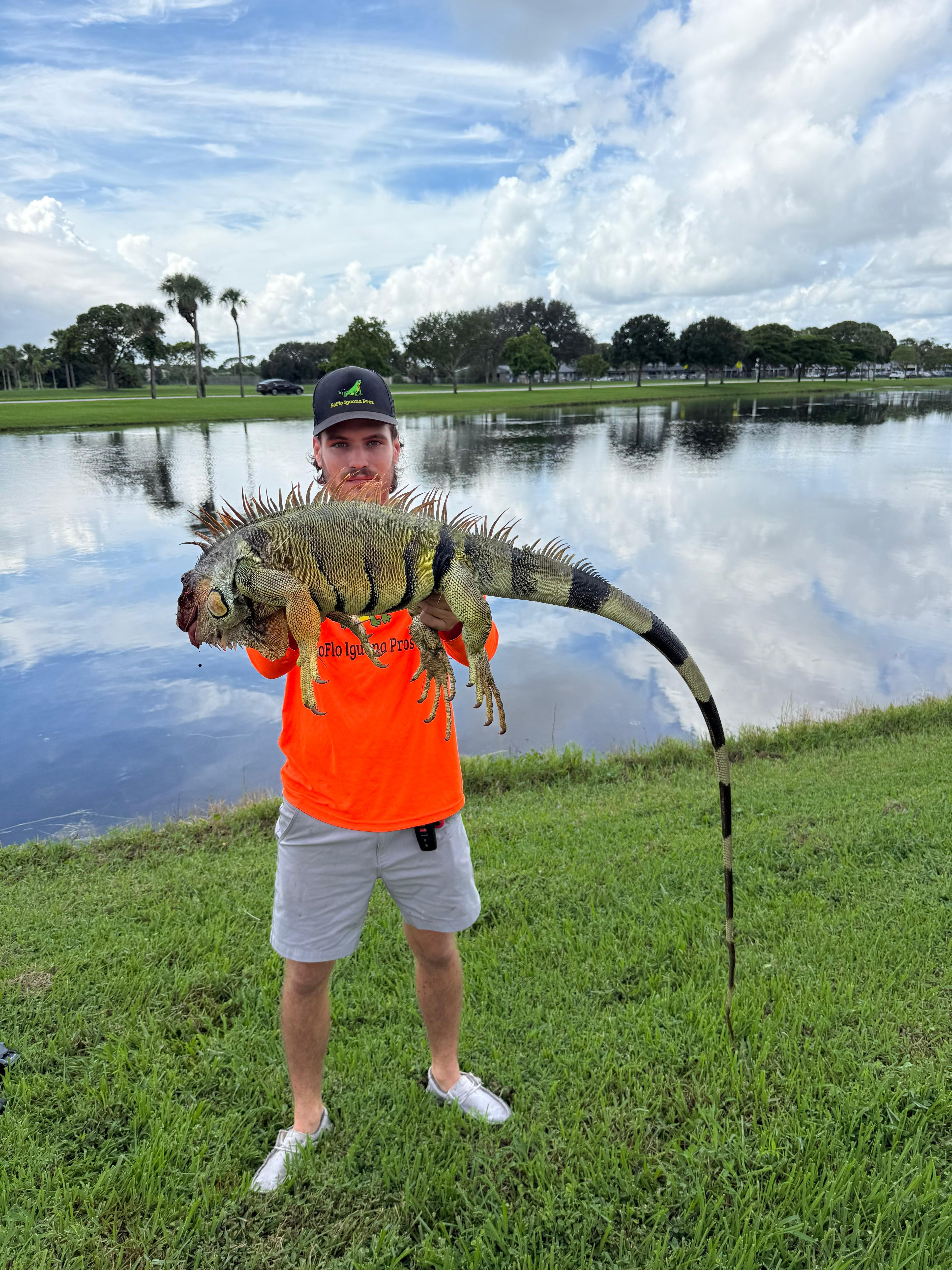
SoFlo Iguana Pros technician with a large iguana by a Palm Beach County lake
Knowledge base

Straight answers on iguanas & South Florida wildlife

What we know from working Palm Beach County properties every day — the biology, the damage, what actually removes them, and what it costs. No fluff.

196+ answers across 8 topics

Iguana biology & behavior

What green iguanas are, how they live in South Florida, and why they do what they do on your property.

10 articles
What is a green iguana?The green iguana (Iguana iguana) is a large, tree-dwelling lizard native to Central and South America — and an invasive species in South Florida.Are iguanas native to Florida?No — green iguanas are not native to Florida. They're an invasive species, established in the south since the 1960s–70s.How big do green iguanas get?Adult green iguanas commonly reach 5 feet nose-to-tail and can top 15 pounds — big enough to do real structural and landscape damage.How fast do iguanas breed in Florida?A single female green iguana can lay roughly 20–70 eggs in a clutch, usually nested in spring — so a couple of iguanas becomes a colony in a season.What do iguanas eat?Green iguanas are mostly herbivores — they graze flowers, fruit, and tender foliage, which is why manicured South Florida landscaping is a magnet.Where do iguanas live and hide on a property?Iguanas bask on seawalls, docks, and roofs by day and den in burrows along banks and against foundations — always close to water.Can iguanas swim?Yes — green iguanas are strong swimmers that dive and stay submerged to escape, which is why canal and lake banks are the worst hotspots.Why do iguanas fall from trees in cold weather?In a hard South Florida cold snap iguanas go cold-stunned and can drop from trees — most aren't dead and revive as it warms.Are iguanas dangerous to people or pets?Iguanas rarely go after people, but they bite, scratch, and tail-whip when cornered, and their droppings can carry salmonella.Why are there so many iguanas in South Florida?Warm year-round weather, miles of canal and seawall to den in, lush landscaping to eat, and no real predators let iguana numbers explode.

Property damage

How iguanas undermine seawalls, docks, foundations, pools, and landscaping — and what it costs.

27 articles
Do iguanas damage seawalls?Yes — iguanas burrow into the soil behind and beneath seawalls, and over time those hollows let backfill wash out and the wall lean, crack, or fail.How do iguana burrows undermine foundations?Iguanas tunnel under slabs, footers, and pool decks, hollowing out the soil that supports them — which leads to settling, voids, and cracks.Do iguanas damage pool decks?Iguanas burrow into the soft ground beside pool decks and screen enclosures, undermining the slab so it settles, cracks, and pulls away from the coping.Are iguana droppings in the pool a salmonella risk?Iguana droppings can carry salmonella, and iguanas that bask around pools frequently leave waste in the water and on the deck — a real sanitation concern.Do iguanas damage docks and boat lifts?Iguanas bask and nest on docks and around boat-lift pilings, fouling surfaces with droppings and burrowing at the piling base where it meets the bank.Do iguanas damage landscaping?Yes — iguanas graze flowers, fruit, and tender foliage and dig burrows through beds, so a manicured South Florida yard is both a buffet and a den site.Why do iguanas eat hibiscus and bougainvillea?Hibiscus and bougainvillea flowers are exactly the soft, colorful blooms iguanas seek out, so these two plants are among the first things they wipe out.Do iguanas damage sidewalks and driveways?Iguanas burrow along the edges of sidewalks and driveways, hollowing out the base soil so slabs settle, crack, and develop trip-hazard lips.Do iguanas damage roofs and gutters?Iguanas climb onto flat roofs and tile to bask, leaving droppings that stain and clog gutters and downspouts, plus occasional damage to loose tile and screening.Do iguanas damage pool cages and screen enclosures?Iguanas climb screen enclosures and sometimes fall inside, tearing screen and bending frames as they try to escape and fouling the enclosed deck.Do iguanas cause canal bank erosion?Iguana burrows riddle canal banks, loosening the soil so rain and boat wake wash it away — accelerating erosion and slumping along the waterline.Do iguanas damage golf course bunkers?Iguanas dig and nest in the soft sand of golf course bunkers and along adjacent lake banks, collapsing bunker faces and leaving droppings across playing surfaces.Do iguanas damage retention and community lake banks?Iguanas honeycomb community and retention lake banks with burrows, causing bank slumping, sinkholes in turf, and erosion that HOAs pay to repair repeatedly.How much does iguana damage cost to repair?Repair costs range widely — from modest resodding to major seawall work in the thousands — depending on what the burrows have undermined and how long it went unchecked.What damage do iguana nesting burrows cause?Nesting females dig especially large, deep burrows in spring to lay clutches — the biggest single burrows and the ones most likely to undermine hardscape.Do iguanas damage air conditioner pads?Iguanas burrow beneath A/C condenser pads for shelter, and the resulting void lets the pad settle or tilt — which can stress refrigerant lines and connections.Do iguanas damage seawall caps?Iguanas burrow into the backfill directly beneath the seawall cap, undermining it so the cap cracks, separates from the panels, or tilts toward the water.What are the signs of iguana burrows?Look for fist-to-dinner-plate-sized holes along banks, seawalls, and slab edges, with fanned-out spoil dirt, packed entrances, and basking iguanas nearby.Do iguanas get into attics or damage the inside of homes?Mostly no — iguanas are outdoor baskers and burrowers, not attic invaders; interior and attic damage is far more likely from rodents or raccoons.How do I tell iguana damage from natural erosion?Natural erosion is broad and even; iguana damage is localized around burrow openings, with spoil dirt, undercut banks, and iguanas basking at the source.What iguana damage do HOAs deal with in common areas?HOAs face burrowed lake banks, undermined sidewalks and pool decks, fouled amenities, and trip hazards across shared common areas — a recurring liability and cost.Do iguanas damage fruit trees?Yes — iguanas climb fruit trees to eat blossoms, young fruit, and tender leaves, and heavy grazing can cut a mango, papaya, or citrus crop short.Do iguanas clog pool equipment?Iguana droppings and debris get pulled into skimmers, filters, and pumps, clogging baskets and fouling the system on properties with heavy iguana traffic.Are iguana burrows near pilings a problem?Iguanas burrow at the base of dock and structural pilings, loosening the fill that holds them steady — a concern for docks, lifts, and pilings on soft banks.How fast do iguanas cause damage?Landscaping can be stripped in days, but structural damage builds over months of repeated burrowing — the harm compounds the longer a population stays.Does insurance cover iguana damage?It varies by policy and is often limited — many homeowner policies exclude gradual damage from animals and earth movement, so check your specific coverage.Do iguanas damage paver patios?Iguanas burrow beneath paver patios and walkways, washing out the sand base so pavers sink, tilt, and separate — leaving uneven, tripping surfaces.

Removal & trapping

How iguanas are removed and trapped humanely, and what actually works versus what doesn't.

27 articles
How does iguana removal work?Removal starts with walking the property to find where iguanas bask, den, and travel, then clearing them with the right method for each spot and collapsing the burrows they nest in.How does iguana trapping work?Trapping puts live-catch cages on the exact routes iguanas already use — seawall caps, dock lines, and burrow mouths — then checks and resets them over repeat visits.One-time removal vs an ongoing program — which do I need?A one-time clear-out fits a light problem away from water; a monitored program fits heavy waterfront and community properties where iguanas keep arriving from the canal or lake.Do iguana traps actually work?Yes — when they're placed on the routes iguanas already use and checked regularly. A trap dropped in a random corner of the yard mostly doesn't.Where should iguana traps be placed?On the routes iguanas already use — seawall caps, dock and piling bases, burrow mouths, and the paths between water and their favorite plants.What bait attracts iguanas?Bright, sweet fruit and flowers work best — mango, cantaloupe, strawberry, hibiscus blooms — because iguanas key on color and sugar.How do you catch an iguana?Either by hand with a catch-pole or net when you can approach one, or by trapping it on its route — but a big adult bites, claws, and tail-whips, so approach matters.How do you get an iguana out of a pool cage?An iguana in a screen enclosure usually can't climb back out, so the move is to open the biggest door, herd it toward the gap, and net it if it won't leave.How do you get an iguana off the roof?Roof iguanas usually climbed a tree, trellis, or downspout to bask — the fix is safe removal plus cutting the access route so they stop coming up.There's an iguana in my house — what do I do?Don't corner or chase it — close off the rest of the house, open the nearest door to outside, and give it a clear path out, then call for help if it won't leave.Do you handle dead iguana removal?Yes — dead iguanas turn up in pools, on decks, and in the yard, especially after cold snaps, and they need prompt, sanitary disposal because droppings and carcasses can carry bacteria.How long does iguana removal take?A single visit runs from under an hour for one animal to a few hours for a full property walk, capture, and burrow collapse — heavy waterfront lots take repeat visits, not longer ones.How many visits does it take to clear iguanas?A light, non-waterfront property can be one visit; a canal or lake lot usually takes several over weeks, and heavy community properties need an ongoing cadence.Catch-pole vs net vs trap — what's the difference?A catch-pole controls an animal you can reach, a net is for a fast one you can corner, and a trap works the property between visits — most jobs use all three.Do iguana repellents work?Honestly, no — sprays and granules might briefly nudge an iguana off one spot, but nothing on the shelf reliably clears or keeps them off a property.Do ultrasonic or motion deterrents work on iguanas?Ultrasonic gadgets don't work, and motion sprinklers only help a little and only for a while — iguanas habituate to anything that never actually harms them.What are humane iguana removal methods?Humane removal means capturing iguanas with minimal stress and handling them within Florida's anti-cruelty rules — live-catch traps that get checked, controlled capture, and proper handling.What happens to iguanas after they're removed?Because green iguanas are invasive, Florida doesn't allow them to be relocated or released — they're handled and disposed of humanely under FWC rules.Can I remove iguanas myself?On your own property, Florida lets you remove green iguanas humanely year-round without a permit — but catching and handling a big adult safely is harder and riskier than it looks.What's the best time of day to remove iguanas?Morning is prime — iguanas are cool, slow, and out basking in the first sun on seawalls and decks, which makes them far easier to spot and catch.How do seasonal iguana trapping programs work?A seasonal program times the work to the breeding cycle — clearing and collapsing burrows before spring nesting so a few iguanas don't become a colony over summer.How do you remove iguanas from community lakes?Retention lakes are iguana factories — soft banks to burrow in and open water to escape into — so they need a monitored trap line along the shoreline, not a one-time sweep.How do you remove iguanas from a seawall?Seawalls are basking spots and burrow sites in one, so removal means trapping along the cap, collapsing the burrows behind the wall, and knowing more will travel in off the water.How does iguana removal work for HOAs?HOAs deal with iguanas across common areas — lakes, seawalls, clubhouse decks — so the fit is a scheduled community-wide program with reporting, not scattered one-off calls.How does iguana removal work for golf courses?Golf courses are wall-to-wall iguana habitat — lakes, bunkers, and manicured turf — so they need a large-scale monitored program that protects both the grounds and player experience.How do I choose the right iguana removal method?Match the method to the situation — direct capture for an animal you can see, trapping for absence and waterfront pressure, and a program when the water keeps resupplying.Why do iguanas come back after removal?They come back because the water keeps supplying new ones, uncollapsed burrows keep producing hatchlings, and the food and cover that drew them are still there.

Prevention & exclusion

Tree wraps, dock guards, burrow collapse, and landscaping changes that keep iguanas from coming back.

27 articles
How do I keep iguanas out of my yard?There's no single trick — keeping iguanas out of a Palm Beach County yard means removing the ones already there, then cutting the food, cover, and burrows that draw more.Do tree wraps actually work on iguanas?Yes — when they're the right height, smooth, and installed correctly. A slick sheet-metal band stops iguanas climbing a trunk; a loose or short one doesn't.How do tree wraps stop iguanas?A tree wrap is a smooth metal band around the trunk that removes the claw-grip iguanas rely on to climb — so they can't get up into the canopy.Do dock-piling guards keep iguanas off my dock?Yes — smooth guards on wood or concrete pilings stop iguanas climbing up to bask and foul the dock, the same way tree wraps stop them on trunks.How does seawall exclusion for iguanas work?Seawall exclusion combines smooth capping, burrow backfill behind the wall, and sometimes a return lip so iguanas can't den in or climb over the wall.What is iguana burrow collapse and backfill?It's finding an iguana burrow, confirming it's empty, then collapsing and packing the tunnel with fill so it can't be reused — a core part of lasting prevention.How can landscaping deter iguanas?Smart landscaping won't repel iguanas, but choosing less-tasty plants, thinning dense cover, and clearing fallen fruit makes a yard far less worth settling into.What plants are iguana-resistant?No plant is truly iguana-proof, but some — tough, aromatic, or thorny species — are far less appealing than the flowers and tender growth iguanas love.What plants attract iguanas the most?Iguanas are drawn to flowers, fruit, and tender new growth — hibiscus, bougainvillea, orchids, and fruit trees are among the biggest magnets in Palm Beach County.How do I protect a pool cage from iguanas?Iguanas climb screen frames and drop in from overhanging trees. Screen guards, cutting back overhead branches, and sealing gaps keep them out of the cage.What are screen guards for pool enclosures?Screen guards are tougher panels or metal mesh fitted to the lower part of a pool cage, where iguanas climb and chew — protecting the weak spot they exploit.How do I protect fruit trees from iguanas?Wrap the trunk to stop climbing, cut branches that bridge from fences or roofs, net or bag the fruit, and clear windfall so the tree stops being a feeding station.Do mothballs repel iguanas?No — mothballs don't reliably repel iguanas, and scattering them outdoors is an illegal off-label use of a pesticide that can poison pets, kids, and groundwater.Do garlic or pepper sprays repel iguanas?No — homemade garlic, pepper, and other scent sprays don't reliably keep iguanas away, and they wash off with the first rain or sprinkler cycle.Do fake owls and predator decoys scare off iguanas?No — plastic owls, hawks, and snake decoys might spook an iguana for a day, but they learn fast that a decoy that never moves is no threat.Do motion-activated sprinklers work on iguanas?They can help in a specific spot — a sudden burst of water startles iguanas — but they're a supporting tactic, not a whole-property solution.How do I fill an iguana burrow properly?Confirm the burrow is empty, then collapse the full tunnel and pack it with compacted fill — not a loose scoop of dirt that gets re-dug overnight.How do I keep iguanas off my seawall?Combine a smooth barrier or cap treatment, backfill of burrows behind the wall, and monitoring — a canal seawall is prime iguana habitat, so it takes layers.How do I keep iguanas out of my flower beds?Cage or fence the beds they target, swap the tastiest flowers for less-appealing plants, thin dense cover, and remove the resident iguanas drawn to them.How do I iguana-proof a waterfront home?Waterfront lots take the most work — seawall exclusion, dock-piling guards, tree wraps, pool-cage screen guards, burrow backfill, and ongoing monitoring together.How does iguana prevention work for HOAs?Community-wide prevention treats the shared lakes, banks, and common areas as one habitat — coordinated removal, burrow backfill, and monitoring across the property.How does iguana prevention work for golf courses?Golf courses combine water hazards, tender turf, and open banks — prevention focuses on bank-burrow control, targeted removal, and scheduled monitoring by hole.How long does iguana prevention last?Physical barriers can last for years, but habitat and burrow control need upkeep — on the water, prevention is an ongoing state, not a permanent one-time fix.What does seasonal iguana prevention maintenance involve?Seasonal upkeep centers on spring nesting — checking and backfilling new burrows, inspecting barriers, and trimming access routes before numbers jump.How do I remove food sources that attract iguanas?Pick up fallen fruit daily, cage or swap the flowers they graze, don't leave pet food out, and stop feeding other wildlife — the buffet is what keeps them coming.Do I need prevention after iguanas are removed?Usually yes — removal clears the current animals, but without burrow backfill and barriers, an empty, attractive property just gets re-colonized.Do fencing and barriers keep iguanas out?Barriers are the most reliable prevention there is — but only when they're built right: smooth, tall enough, no gaps, and closing every route the animal actually uses.

Law, safety & humane methods

Florida's FWC rules, what's legal on your own property, disease and pet-safety facts, and humane handling.

25 articles
Is it legal to remove iguanas in Florida?Generally yes — green iguanas are an invasive, unprotected species, and Florida lets a homeowner remove them humanely from their own property year-round without a permit.What are the FWC rules on green iguanas?Under FWC guidelines green iguanas are treated as invasive and unprotected — encouraged to be removed humanely, but never relocated and released elsewhere.Do I need a permit to remove iguanas?Generally no — a homeowner usually doesn't need a permit to humanely remove green iguanas from their own property, but rules differ off your land.Does iguana removal have to be humane by law?Yes — even though iguanas are invasive and unprotected, Florida's anti-cruelty law still applies, so removal and dispatch must be done humanely.Can you shoot iguanas in Florida?It depends heavily on local ordinances and safety — discharging firearms or air guns in residential Palm Beach County areas is often restricted, and we don't advise it in neighborhoods.Is it legal to relocate iguanas?No — because green iguanas are invasive, they generally cannot be caught and released somewhere else; captured iguanas are not relocated and set free.Do iguanas carry disease?Iguana droppings can carry salmonella bacteria, which is the main everyday health concern — especially on pool decks, docks, and patios people use barefoot.Are iguanas dangerous to pets?Iguanas don't hunt pets, but a dog or cat that corners a big iguana can be bitten, scratched, or tail-whipped — and droppings pose a salmonella risk.What should I do about an iguana bite?Iguana bites can be deep and carry infection risk — general first aid is to clean the wound and control bleeding, but see a doctor, especially for deep bites.Are iguana droppings a health risk?Yes — iguana droppings can carry salmonella and tend to accumulate on decks, docks, and seawalls, making cleanup and reduced populations a real sanitation issue.Are iguana-removal companies licensed?Legitimate operators generally hold pest-control or wildlife licensing and carry insurance — it's worth confirming, because 'licensed and insured' protects you.What does 'FWC-compliant' iguana removal mean?It generally means the work follows current FWC guidance for invasive iguanas — humane handling, no illegal relocation, and lawful, humane dispatch and disposal.Can an HOA require iguana removal?Often, yes — HOAs can generally address nuisance and property upkeep through their governing documents, but exactly what they can require depends on those docs and Florida law.Is an HOA liable for iguana damage?It depends on the governing documents and the facts — associations may have upkeep duties for common areas, but liability is a legal question for an attorney, not us.How do I keep pets safe during iguana removal?Keep pets indoors or away from traps and work areas during removal, and don't let them near captured iguanas, droppings, or set traps.Is poison legal for iguanas?No — there's no approved poison or bait to kill iguanas, and using unapproved toxicants is both illegal and inhumane, so we never use them.Are iguanas a salmonella risk around the pool?Yes — iguanas love pool decks and often leave droppings in or near the water, so cleanup, disinfection, and reduced populations matter for pool safety.Are iguanas protected or endangered in Florida?No — green iguanas are invasive, not protected or endangered in Florida, which is why homeowners may remove them humanely without a permit.How do I report iguanas to FWC?FWC generally encourages the public to report invasive species like iguanas through its reporting channels — check the current FWC website for the current form and app to use.What are the humane handling and euthanasia rules for iguanas?At a high level, iguanas must be handled and dispatched humanely under recognized guidelines — this is general information, and dispatch is best left to trained professionals.Can I trap iguanas on my property?Generally yes — trapping invasive iguanas on your own property is usually allowed, but traps must be humane, monitored, and placed lawfully; off your land, rules differ.Does homeowners insurance cover iguana damage?It depends on your policy — many policies exclude gradual pest and animal damage, but coverage varies, so this is a question for your agent and policy, not us.How do I keep kids safe around iguanas?Teach kids not to touch, chase, or corner iguanas, keep them away from droppings, and wash hands — the main risks are bites, scratches, and salmonella.What should I do if I find iguana eggs?Iguana eggs found in a burrow are generally fair to remove since iguanas are invasive, but be sure they're iguana eggs and not a protected native's — when unsure, ask a pro.Why does hiring licensed and insured matter legally?Licensing and insurance protect you — they mean the work is done to recognized standards and that you're not left liable if something goes wrong on your property.

Other wildlife

Cane toads, raccoons, opossums, Muscovy ducks, Egyptian geese, and coyotes across South Florida.

28 articles
Are cane toads dangerous to dogs?Yes — a cane toad (bufo toad) can poison a dog in minutes. The toxin comes from glands behind the head, and small dogs are most at risk.How do I tell a cane toad from a native Florida toad?Size and the glands are the tell: invasive cane toads get large (4–6+ inches) with big triangular glands over the shoulders; native southern toads stay small with rounded glands.What do I do if my dog licks or bites a cane toad?Rinse the dog's mouth from the side with a hose for several minutes so water runs out, not down the throat — then get to a vet immediately.How do you get rid of cane toads?Cane toads are cleared after dusk by hand — no poisons near pets — after confirming the ID, then by cutting the water, pet food, and lighting that draw them in.When is cane toad breeding season in Florida?Cane toads breed most in the warm, wet months, laying long strings of eggs in standing water — which is why summer is when a few toads become a nightly crowd.How do you remove raccoons from an attic?Find every entry and the den, remove the animals (young included, by hand in season), seal and reinforce the roofline, then decontaminate the droppings.What are the signs of raccoons in your house?Heavy footsteps and scratching after dark, chittering young, a torn soffit or vent along the roofline, piling droppings, and a musky smell.Are raccoons dangerous?They can be — raccoons are a rabies vector species in Florida and their droppings can carry roundworm, so a latrine near kids or pets is a real health concern.Raccoon roundworm and droppings cleanupRaccoon latrines can carry roundworm (Baylisascaris), which is why droppings and soiled insulation are decontaminated — not just swept up or sealed behind drywall.Raccoon baby season and humane removalIn spring a female dens to raise a litter — usually in an attic or chimney. Skip the young and she'll tear the structure apart, so the whole family comes out together.How do I keep raccoons out of the trash?Secure the cans (lids that latch or strap down), stop feeding them by accident, and remember a fed raccoon is the one that eventually tries your roofline.Why is an opossum living under my deck?A dry, dark space under a deck or porch is prime denning cover, and there's usually food nearby. It's the number-one opossum call we get.Are opossums dangerous?Not really — the Virginia opossum is slow, shy, and about the least aggressive animal in your yard. Its whole defense is to hiss, bare its teeth, or play dead.Are opossums actually beneficial?Largely yes — an opossum patrolling the yard eats ticks, roaches, snails, slugs, and even rats and mice. Often the animal isn't the problem, the den location is.How do you get rid of opossums?Exclusion-first: get the opossum to leave on its own with one-way doors, then seal decks, sheds, and crawlspaces, and remove the food that drew it in.Why are Muscovy ducks a problem?A settled Muscovy flock fouls docks, decks, and walkways, hurts small-lake water quality, gets aggressive around feeding and nesting, and overpopulates fast.Is it legal to remove Muscovy ducks in Florida?Yes — Muscovy ducks are a non-native, domestic-origin bird, not protected native waterfowl. A USFWS control order allows their removal and nest and egg management.Muscovy ducks on community lakesCommunity lakes are where most Muscovy work happens — assessed as a system, with nest and egg management so the flock can't quietly rebuild.Egyptian geese in Florida — an invasive birdEgyptian geese are a non-native, invasive species spreading across South Florida communities and golf courses — territorial, messy, and quick to overpopulate.Are Egyptian geese aggressive?Yes — they're intensely territorial, especially when nesting. A defending goose chases people, kids, and pets off the lawn and dive-bombs anyone near the nest.How do you get rid of Egyptian geese?Assess the property and flock, remove the resident birds under the rules for non-native species, manage the nests and eggs (including rooftop sites), then deter.Are there coyotes in Palm Beach County?Yes — coyotes are established in every Florida county, Palm Beach included, denning in preserves, greenbelts, canals, golf courses, and vacant lots.Are coyotes dangerous to pets?The real risk is to small pets. A cat or small dog left out at dawn, dusk, or overnight is what a bold coyote will go after — we won't dress that up.How do I keep coyotes away?Cut the easy food, protect pets at dawn and dusk, and haze bold coyotes so the yard stops feeling safe — attractant removal does most of the work, not traps.Do coyotes attack people?Very rarely. Documented attacks on humans in Florida are uncommon, and coyotes usually want nothing to do with you — the real risk is to small pets.What attracts wildlife to your yard?Food, water, and shelter — open trash, pet food left out, fallen fruit, standing water, and easy denning cover are what turn a yard into a nightly stop.When should I call a wildlife removal pro?When something's living in the structure, there may be young, there's a health or pet-safety risk, or DIY hasn't held — that's when a pro is worth it.Dead animal removalA dead animal in a wall, attic, or crawlspace means locating the source, removing it, and decontaminating — because the smell and the health risk don't fade on their own.

Palm Beach County

Local pressure by city, waterway, and season — from the Intracoastal seawalls to the community lakes out west.

26 articles
Iguana removal in West Palm BeachIguana removal across West Palm Beach — from the Flagler Drive Intracoastal seawalls to the fruit-tree canopy in El Cid and Flamingo Park.Iguana removal in Boca RatonIguana removal in Boca Raton — Intracoastal and Spanish River canal seawalls, gated-community lakes, and the pool-cage calls that spike every summer.Iguana removal in Delray BeachIguana removal in Delray Beach — the Tropic Isle finger canals, Lake Ida banks, Pineapple Grove canopy, and the golf communities like Del-Aire.Iguana removal in Boynton BeachIguana removal in Boynton Beach — the marina district seawalls, the 55-plus retention lakes at Leisureville and Hunters Run, and canal-backed subdivisions west of Congress.Iguana removal in WellingtonIguana removal in Wellington — where burrows under paddocks and arena footing are a genuine horse-injury risk, plus the C-51 canal network feeding every backyard.Iguana removal in Lake Worth BeachIguana removal in Lake Worth Beach — our home turf. The lagoon front, the Lake Osborne banks, and the bungalow streets of Parrot Cove and College Park.Iguana removal in Palm Beach GardensIguana removal in Palm Beach Gardens — golf-community retention lakes at PGA National, Mirasol, and BallenIsles, plus Intracoastal waterfront on the east side.Iguana removal in North Palm BeachIguana removal in North Palm Beach — a village built around the water, with finger canals, the North Palm Beach Waterway, and the country-club lake banks.Iguanas on the IntracoastalThe Intracoastal and Lake Worth Lagoon are the county's iguana superhighway — seawalls to den in, docks to bask on, and open water to escape into.Iguanas in Palm Beach County canalsThe county's drainage canals — the C-51, C-15, C-17, E-4 and the community networks — are the routes iguanas use to reach almost every backyard inland.Iguanas in community and retention lakesThe retention lakes behind nearly every HOA and golf community in the county are ideal iguana habitat — soft banks to burrow, lawns to graze, water to escape into.Iguana pressure by season in South FloridaIguana activity in Palm Beach County follows the calendar — quiet in cold snaps, building through spring nesting, and peaking in the summer heat.Iguana nesting season in South FloridaIguanas nest in spring, digging burrows to lay clutches of 20–70 eggs — which is why spring is the leverage point for getting ahead of the population.Worst months for iguanas in FloridaThe worst stretch runs from spring nesting into the peak of summer, when adults are most active and this year's hatchlings are everywhere.Iguanas and hurricane seasonHurricane season overlaps peak iguana activity, and storms scatter animals, wash out banks, and turn debris and standing water into fresh iguana habitat.Iguanas in gated communitiesGated communities across the county share the same iguana engine — retention lakes, shared seawalls, and connected canals that no single homeowner can fix alone.Iguanas on Palm Beach County golf coursesGolf courses combine everything iguanas want — lake banks to burrow, tender fairway and green turf to graze, and clubhouse beds to strip — at large scale.Waterfront iguana problemsWaterfront lots take the heaviest iguana pressure in the county — seawalls to den in, docks to bask on, and water to dive into the moment you approach.Why Palm Beach County has so many iguanasYear-round warmth, endless waterfront and canal bank, lush ornamental landscaping, and no real predators make Palm Beach County close to ideal iguana habitat.Iguanas in Wellington's equestrian areasIn Wellington's equestrian neighborhoods, iguana burrows under paddocks, arena footing, and canal berms are a genuine horse-injury hazard — not just a nuisance.Iguanas near Lake OsborneLake Osborne and its connected canals in the Lake Worth area drive heavy bank burrowing that eats away at yards, boat lifts, and seawalls.Iguanas and the C-51 canalThe C-51 canal is a main iguana artery through Wellington and West Palm Beach, feeding animals from the water-management system into connected neighborhood canals.Best time of year for iguana removalThe highest-leverage time to remove iguanas is late winter to early spring, before nesting — clearing and collapsing burrows then prevents the summer population jump.Do iguanas move between properties?Yes — iguanas travel along seawalls, canal banks, and shared lake shorelines, which is why one cleared lot reinfests from the neighbor's water next door.How cold does it get in Palm Beach County? (iguana cold-stun)Palm Beach County rarely gets cold enough, long enough, to control iguanas — but the occasional snap into the 40s can cold-stun them, and they drop from trees.Choosing a local iguana company vs a national chainA local iguana specialist knows the county's waterways, responds same-day, and monitors a property across a season — advantages a national pest chain can't match.

Cost & hiring

What removal and programs cost, DIY versus a pro, and how to choose a licensed, insured company.

26 articles
How much does iguana removal cost?Single-visit iguana removal in Palm Beach County starts from $189, and monitored monthly programs start from $99/mo — with the exact number quoted after a free property walk.Iguana removal pricing, explainedPricing comes down to two paths: a one-time clear-out from $189, or a monitored monthly program from $99/mo — with community sites quoted to the property.How much does an iguana trapping program cost?Monitored iguana trapping programs in Palm Beach County start from $99/mo, with community-scale sites quoted after a bank-mapping assessment.Is the iguana removal quote free?Yes — the property walk and written quote are free, with no charge and no pressure to book.Do iguana removal companies require contracts?Some do — but we don't lock you in. Our ongoing programs run month to month and you can cancel anytime.DIY vs. professional iguana removalYou can legally remove iguanas from your own property in Florida, but a full-grown adult bites, scratches, and tail-whips — and burrows need collapsing properly to matter.How to choose an iguana removal companyLook for licensed and insured, humane FWC-compliant methods, a free written quote, no lock-in contract, and local knowledge of Palm Beach County's waterways.Questions to ask an iguana removal companyAsk about licensing and insurance, humane methods, what's included, whether the quote is free, contract terms, and how they handle burrows and prevention.Are cheap iguana removal services worth it?A low price often means the burrows and access points get skipped — so the iguanas come back and you pay twice. Cheap isn't the same as good value.What affects the cost of iguana removal?Property size, how many iguanas are established, burrowed seawalls, waterfront access, and whether you want a one-time fix or ongoing control all move the price.How much does iguana removal cost for an HOA?HOA iguana programs are quoted to the community after a bank-mapping assessment — priced to the retention lakes, seawalls, and shared grounds we're covering, with documentation for the board.How much does iguana removal cost for a golf course?Golf course programs are quoted to the property — priced to the number of retention lakes, bank footage, and fairway edges we're managing, with reporting for the club.How much is monthly iguana control?Monitored monthly iguana control for a residential property starts from $99/mo, with community-scale programs quoted to the site.One-time removal vs. monthly cost: which is cheaper?A single visit is a lower upfront number (from $189), but if iguanas keep returning, a monitored program (from $99/mo) usually costs less over a season.Do you pay per iguana?No — pricing is by the job, not by the head. A one-time visit starts from $189 and a monitored program from $99/mo, regardless of the exact count.How much does emergency iguana removal cost?Emergency and same-day iguana calls are quoted to the situation — an iguana in the house, stuck in a pool cage, or on the roof — with a straight price before we head out.How much does dead iguana removal cost?Dead iguana removal is quoted to the situation and often runs as a fast same-day call — we'll give you a straight price before heading out.Is iguana removal covered by insurance?Usually not — most homeowners policies treat pest and wildlife removal as maintenance rather than a covered loss, but check your specific policy.How to get an iguana removal quoteCall or message us, tell us the property and what you're seeing, and we'll schedule a free property walk and give you a written quote — no charge, no pressure.Why licensed and insured mattersLicensing and insurance protect you if something goes wrong on your property, and signal that the company works within FWC's humane, legal requirements.Red flags in wildlife removal companiesWatch for no license or insurance, firm prices quoted sight-unseen, per-iguana billing, lock-in contracts, vague methods, and no mention of burrows or prevention.Guarantees and what to expectExpect a written plan, humane FWC-compliant work, and honesty about waterfront reality — no one can promise a canal-front property stays iguana-free forever after one visit.What's included in iguana removal?A single visit from $189 includes a full property walk and burrow map, hand-catch and catch-pole removal, burrow collapse where needed, and written prevention recommendations.How fast can someone come out?We run same-day response across Palm Beach County, seven days a week — with emergency calls like an iguana in the house handled as fast as we can get there.Do I need ongoing iguana service?It depends on your property — waterfront and canopy lots usually need ongoing control, while inland yards with a few iguanas may do fine with a one-time visit.How much does iguana prevention cost?Prevention work — tree wraps, dock-piling guards, and burrow collapse — is quoted to the property and often bundled with removal so you stop paying to remove the same iguanas.
Call (561) 735-1975