
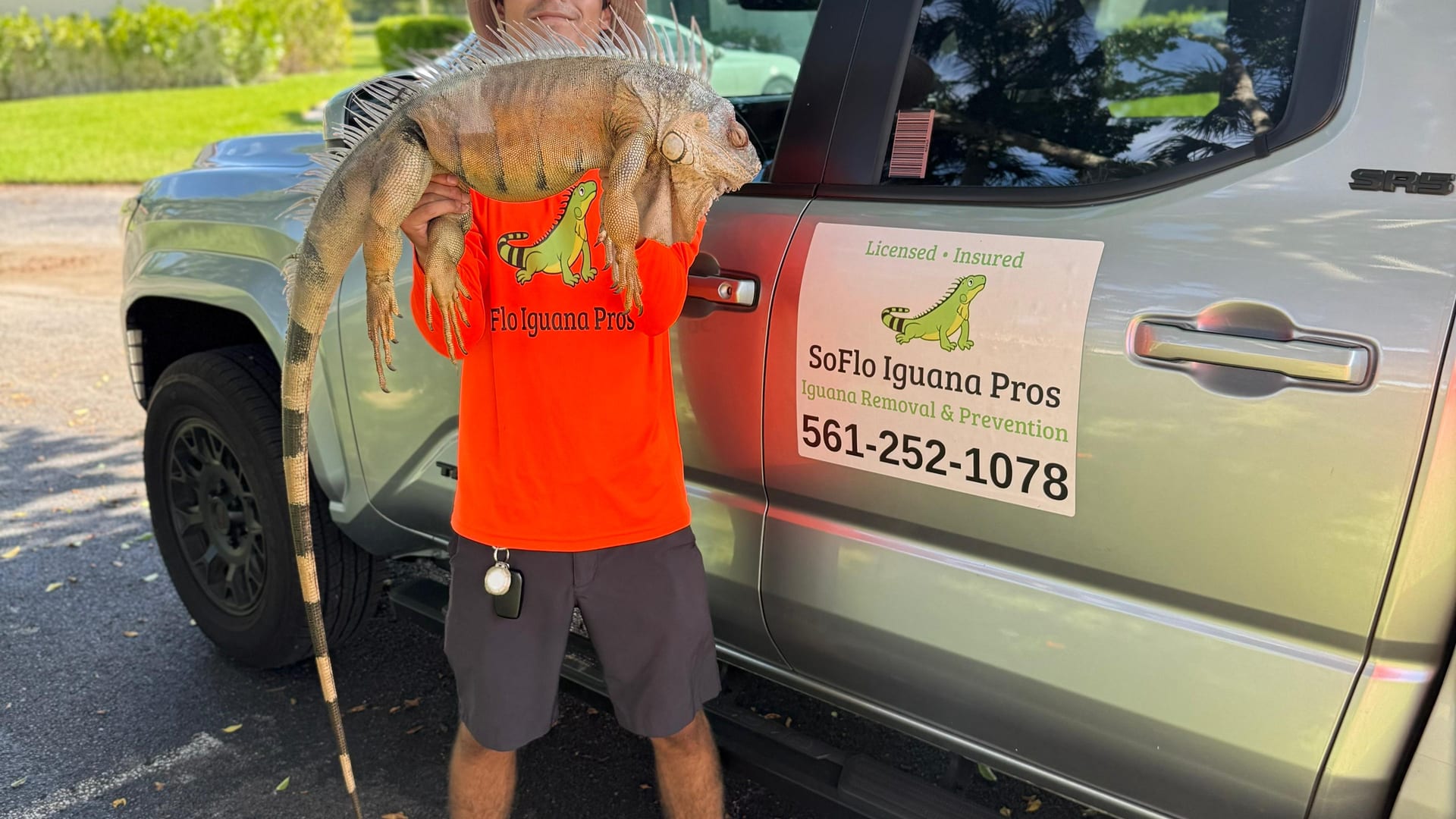
Iguana removal that ends the problem — not just today's iguana
We clear the iguanas already on your Palm Beach County property — off the seawall, out of the burrows, down from the roof — with humane, FWC-compliant methods, then close the gaps that let them in. Same-day across the county, from $189.
Same-day
7 days a week
$189+
single visit, no contract
5.0
123+ Google reviews
Licensed
insured · FWC-compliant
The green iguana isn't a lizard problem. It's an invasive-species problem.
Green iguanas (Iguana iguana) aren't part of the native Florida landscape — they were introduced through the pet trade and hitchhiking on cargo, and South Florida's climate let them run. Palm Beach County, with its canals, seawalls, and year-round warmth, is about as good as it gets for them. That's why this isn't a once-in-a-while nuisance here; it's a standing pressure that builds on any waterfront property left unmanaged.
Understanding the animal is half the job. They bask by day, burrow into banks to nest, swim and hide underwater, and breed fast enough that a quiet spring turns into a summer infestation. Treat the symptom — the one on the seawall this morning — and you'll be back on the phone in three weeks. Treat the animal's behavior — the burrows, the nests, the climb routes — and you actually get ahead of it.
The upside of their invasive status is that the law is on your side. Florida wants them off private property, and a licensed removal handled humanely and correctly is both legal year-round and genuinely effective. That combination is exactly what we do.
Four spots do almost all the damage.
Nearly every iguana call in Palm Beach County comes down to the same handful of places — along the Intracoastal, the C-51 canal, and the community lakes especially. We work all of them on the same visit.
Seawalls & canal banks
They bask on the cap by morning and dig dens straight into the bank. Left alone, those tunnels hollow out the wall until the cap cracks and the soil behind it washes into the canal.
Roofs, balconies & pool cages
Iguanas climb to bask on flat roofs and screen frames, then drop into pools and lanais they can't climb back out of. We pull them out and find the climb route they're using.
Burrows by foundations & decks
A single female digs a nesting burrow six feet or longer under a patio, driveway, or A/C pad. The hardscape settles and cracks above it, and next season there are a dozen more.
Fruit trees & thick beds
Hibiscus, bougainvillea, and any fruit tree are a buffet and a hideout. If the yard feeds and hides them, removal alone never sticks — so we flag exactly what to change.
The signs you actually have iguanas — not just one passing through.
One iguana sunning on the dock is nature. Any two or three of these together means they've settled in and it's worth a call before spring nesting turns a handful into a colony.
Call (561) 735-1975- Iguanas basking on the seawall cap, dock, or pool deck at first light
- Half-moon burrow openings at the waterline or tucked against the foundation
- Hibiscus, bougainvillea, orchids, or fresh sod chewed down to stubs
- Dark, seed-flecked droppings collecting on the deck, dock, or lanai
- Thumps or scratching on a flat roof — or one dropped into the pool cage
- Dug nests or hatchlings in spring, a sign a female laid nearby
A clear-out is easy. Keeping them gone is the job.
Anyone can net an iguana off a seawall for the afternoon. The steps most companies skip — mapping the property, collapsing the burrows, and coming back — are the ones that actually end it.
- 1
Walk it & map it
Free walk of the seawall, yard, and roofline to find the burrows, runs, and basking spots. The map matters more than the head count.
- 2
Hand & catch-pole
We take everything we can reach on the spot — off the wall, out of the cage, down from the roof — quickly and without drama for the neighbors.
- 3
Targeted traps
Monitored traps go on the exact spots iguanas are already using, not scattered around. We check and move them as behavior shifts.
- 4
Collapse & wrap
We pack the burrows so the bank stops washing out, then wrap trees and dock pilings so the climb routes are gone.
- 5
Come back & confirm
A scheduled follow-up to catch stragglers and confirm the pressure is actually down — with a record you can hand a property manager.
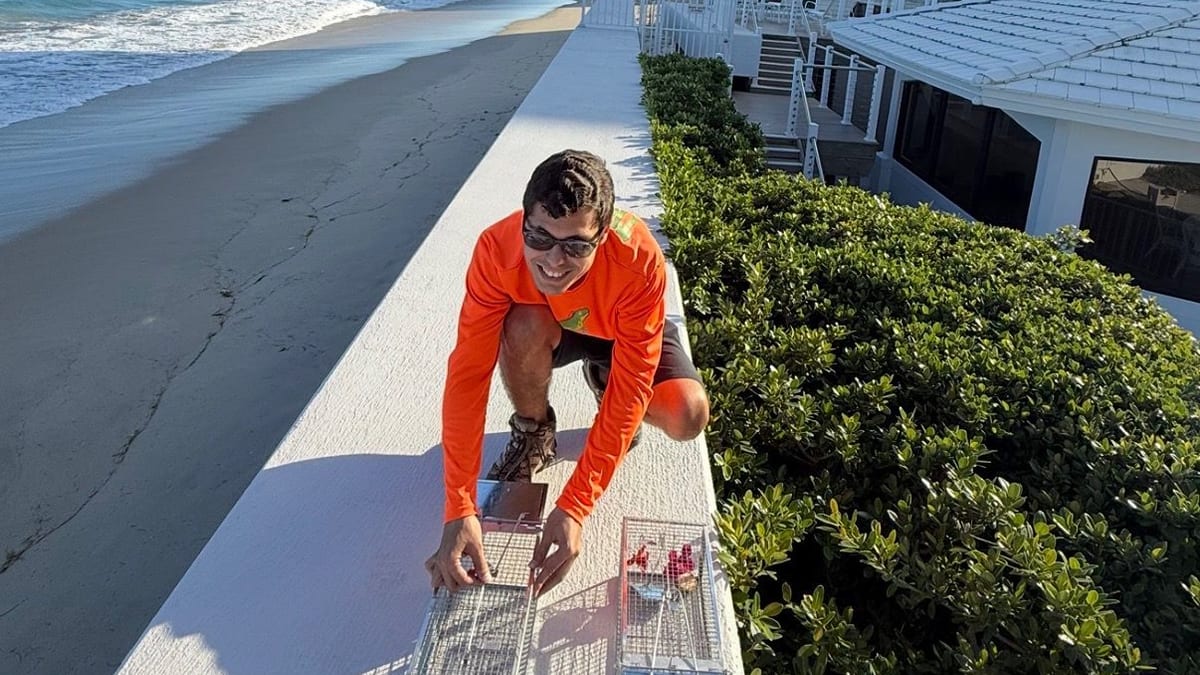
Handled the way FWC actually requires.
Green iguanas are invasive, so Florida lets you remove them from your own property year-round — but the method matters. We don't use poisons, and we don't turn a suburban backyard into a shooting range. Reachable iguanas are taken by hand or catch-pole; the rest go into monitored traps.
- Humane capture — no poisons, no repellent gimmicks that don't work
- Discreet on waterfront estates and shared HOA common areas
- Licensed & insured, with the paperwork a board or manager can file
Repellents and one-off grabs don't hold. Here's why.
We get called after the hardware-store fixes fail all the time. There's no shame in trying them — they just don't match how the animal behaves. The four most common ones and what actually happens:
Store repellents & garlic sprays
Wash off in the first afternoon storm, and iguanas learn to ignore them within days.
Motion sprinklers & noise makers
They habituate fast once nothing bad actually happens, then move right back in.
Filling a single burrow
They re-open it overnight or dig the next one down the bank if the spot still suits them.
Grabbing only the visible ones
Leaves the burrows, eggs, and climb routes that reseed the yard within weeks.
None of it is a scam — it's just aimed at the symptom. The fix is unglamorous: find the burrows and nests, remove the animals correctly, collapse the dens, and cut off the climb. That's labor and know-how, not a spray, which is exactly why it lasts.
Iguana pressure runs on a South Florida calendar.
The problem isn't flat year-round, and knowing where you are in the cycle changes the plan. Spring is the leverage point — clear them before the nests hatch and you save yourself the summer.
Spring
Females dig and lay; hatchlings appear. The best window to break the cycle before numbers jump.
Summer
Warm, wet months mean heavy feeding and fast growth — landscaping and burrow damage crest.
Fall
Territorial activity climbs and adult males get bold and highly visible around the property.
Winter
Cold snaps can knock them from trees and slow things down, but survivors return with the first warm days.
Straight pricing, no lock-in.
A one-time clear-out starts at $189. That covers a real visit — not a drive-by — where we work the property, take the iguanas we can reach, and set traps on the spots that matter. Where a property needs more than one pass — a long seawall, a community lake bank, an HOA with dozens of burrows — we quote a monitored program instead, priced to the property and cancelable any time. Either way the number is in writing before we lift a net, and the property walk that gets you that number is free.
What a first visit includes
- A walk of the seawall, yard, and roofline to map the burrows, runs, and basking spots.
- Hand and catch-pole removal of every iguana we can safely reach that day.
- Monitored traps placed on active runs — and a plan for the follow-up if the pressure warrants it.
- A written price and honest read on whether one visit will do it or you're better off on a program.
What moves the price
Three things, mostly: how much waterfront and how many burrows we're dealing with, how established the population is, and whether you want them simply gone today or kept gone through the season. A single iguana in a pool cage is a quick, flat call. A quarter-mile of HOA lake bank that hasn't been touched in two years is a program. We'll tell you which one you actually have — and we won't upsell you into a contract to pad a route.
What you're paying for isn't a guy with a net. It's knowing which burrow to collapse, which dock piling they climb, and which follow-up visit actually drops the population instead of resetting it. That judgment is the difference between one invoice and a monthly one — and it's why customers who tried the cheap route first end up calling us to finish the job right.
Homes, estates, HOAs & golf
We run single-family yards and waterfront estates, condo and HOA common areas, and golf-course lakes and greens across Palm Beach County — from a single seawall in Lake Worth Beach to miles of lake bank in Wellington. HOA boards and property managers get itemized documentation they can file and hand to residents; homeowners get a straight answer and a fair price. Same license, same insurance, same follow-up — whatever the size of the job.
Iguana removal across Palm Beach County.
We're based in Lake Worth and cover the county end to end — the Intracoastal seawalls on the coast, the canal neighborhoods inland, and the community lakes out west. Most addresses get a same-day or next-morning visit. Pick your city for the local rundown.
A look at the work.
Real removals from around Palm Beach County — seawalls, lake banks, and waterfront yards, plus the prevention that comes after.
Tap any photo to enlarge
What removal customers say.
Iguana removal questions.
Not sure what you're dealing with?
Call or text Nick — he'll tell you what's going on and what it takes, straight.
Call (561) 735-1975How do you remove iguanas — do you kill them on site?
We take the reachable ones by hand and catch-pole and set monitored traps for the rest. Green iguanas are an invasive species in Florida, so they're handled under FWC guidelines — humanely and without poisons, air-rifle theatrics near homes, or anything that puts pets and kids at risk.
Can you get an iguana out of my pool cage or off the roof today?
Usually, yes. We're based in Lake Worth and run same-day and emergency calls across Palm Beach County seven days a week. Call (561) 735-1975 and tell us where it is and we'll tell you the soonest we can be there.
Do you handle seawall and burrow iguanas, not just the ones I can see?
That's the core of the job. We pull them off the seawall, clear the burrows, then collapse and pack the dens so the bank stops eroding and they lose the den site. Removing the visible ones without touching the burrows is why the problem comes back.
Will the iguanas just come back after you leave?
They will if all you do is remove them. That's why every removal finishes with prevention — burrow collapse, tree and dock-piling wraps, and the landscaping changes that make your property the hard one on the block. It's the difference between one call and a monthly bill.
How much does iguana removal cost in Palm Beach County?
Single visits start at $189. The final price depends on the property size, how many iguanas and burrows we find, and whether you want a one-time clear-out or an ongoing program. The property walk and written quote are free, and the price is set before we start — no contract you can't cancel.