
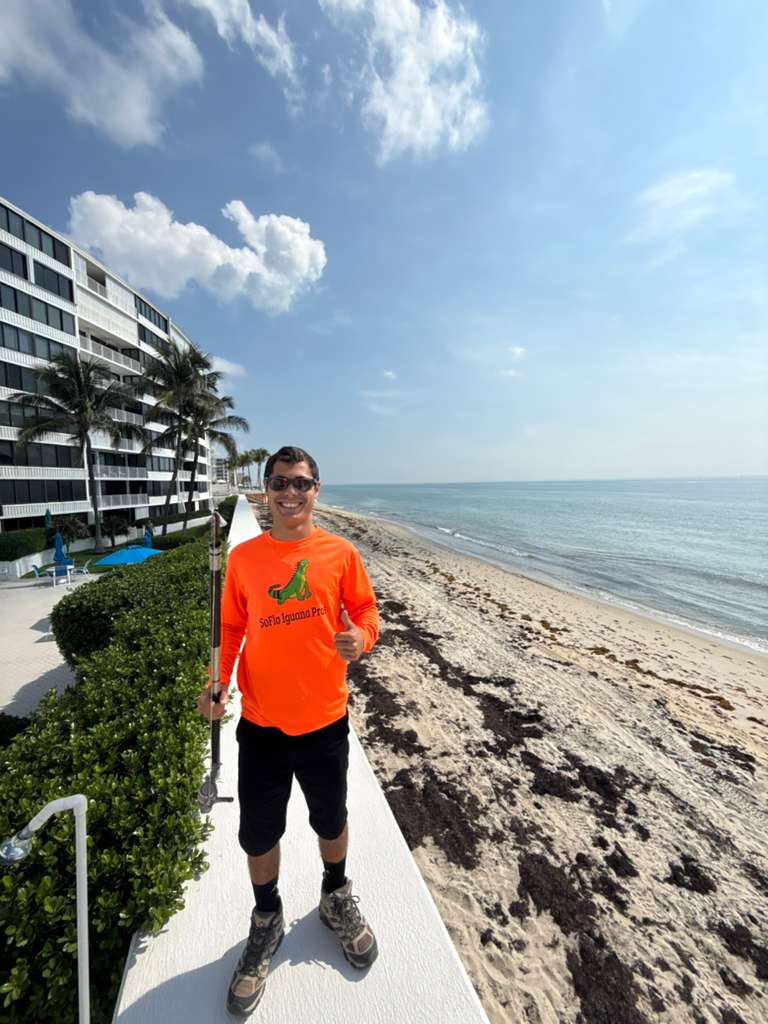
A seawall is the single most iguana-friendly feature on most waterfront lots. The cap makes a perfect basking bench, the soil behind and beneath it is easy to burrow into, and the water is right there for escape. That burrowing isn't just a nuisance — it's one of the ways iguanas actively contribute to seawall failure, hollowing out the backfill until the cap cracks or settles. Exclusion targets both the surface the animals bask on and the ground they den in.
The work is site-specific because no two seawalls are quite the same, but it usually combines a few things: locating and backfilling the burrows behind and under the wall, adding a smooth barrier or return so animals can't get a grip climbing up or over the cap, and treating the adjoining bank so they can't simply re-dig right next to the treated section.
The three parts of a good job
We think of seawall exclusion as three separate problems that have to be solved together, because leaving any one open undermines the others.
- Ground — find and backfill burrows behind and under the wall so there's no den or erosion void
- Surface — add a smooth cap treatment or return lip so the wall is hard to climb and grip
- Edges — treat the adjoining bank and corners so animals can't re-dig alongside the work
Honest limits
Exclusion reduces pressure a great deal, but on an active canal it doesn't make a wall iguana-proof forever. Burrows get re-dug from the waterline, and new animals arrive off the canal constantly. That's why waterfront properties do best on a monitored program that catches re-colonization early rather than a single install that's assumed to hold indefinitely. We'd rather set that expectation up front than have you feel misled a season later.
Common questions
Does exclusion fix seawall damage that's already there?
No — exclusion prevents further burrowing, but existing voids and cracks are a marine-contractor repair, not something we handle. What we can do is flag what we find behind the wall during the work so it gets addressed before it gets worse.
Is this a one-time job?
The install is largely a one-time thing, but the canal doesn't stop sending iguanas. Most seawall clients pair the exclusion work with periodic monitoring, because a wall that's been treated once will slowly re-colonize on open water if nobody's watching it.
Will exclusion work if my neighbor does nothing?
It still helps on your side, but a neighbor's untreated seawall a few feet away keeps feeding animals along the shared shoreline. On tight canal lots, coordinating with the neighbor — or at least treating your edges thoroughly — makes the result hold much better.

