
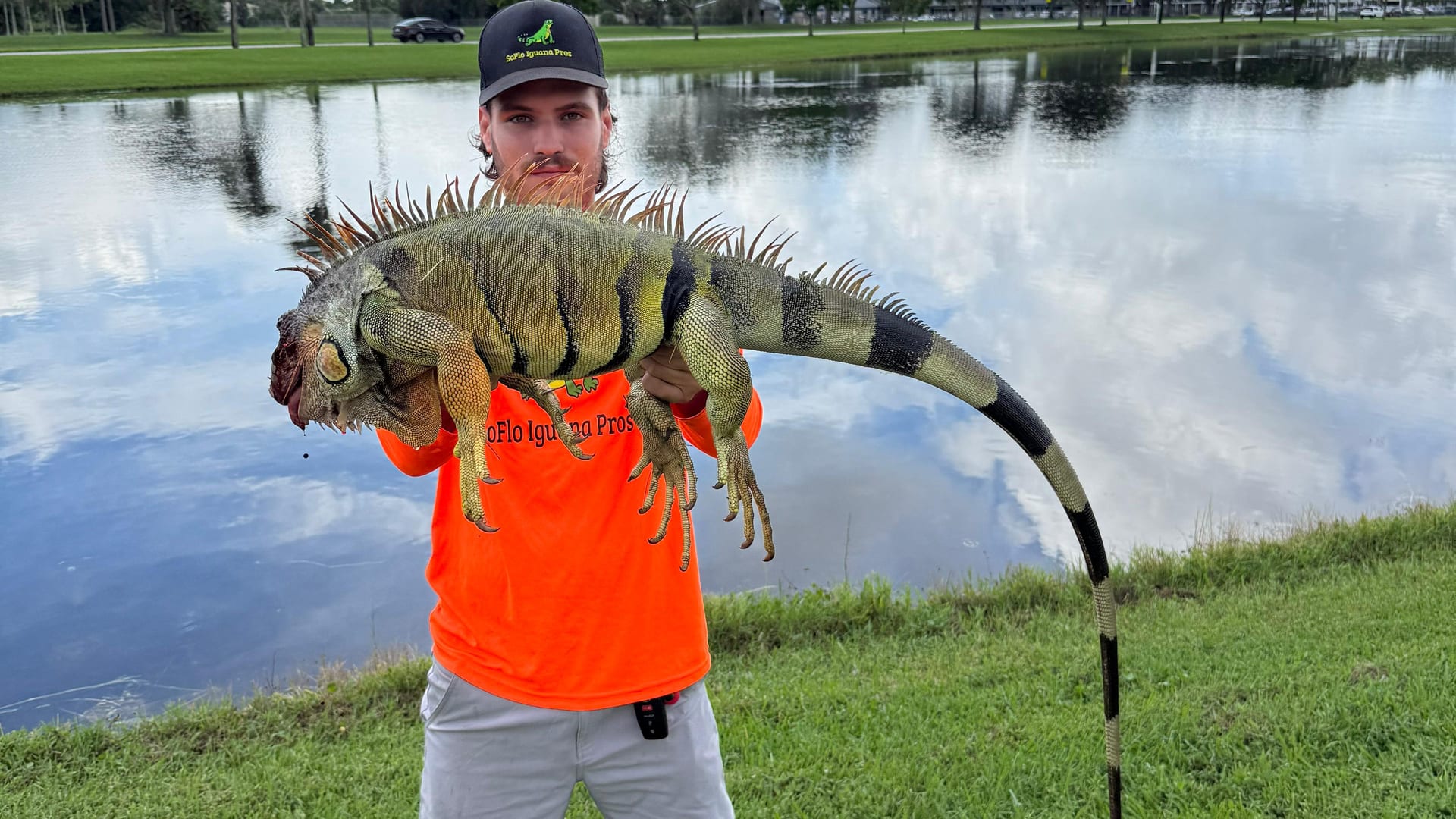
Golf course iguana control that works around your tee sheet
Iguanas turn lake banks, bunker faces, greens, and cart paths into a standing agronomy and infrastructure cost. We run a monitored program built for a course — mapped hole by hole, scheduled around play, and reported back to the super — so the damage stops without slowing a single round. Free course assessment.
Around play
worked to your tee sheet
Scheduled
recurring, reported program
Licensed
insured · FWC-compliant
5.0
123+ Google reviews
A course is one big iguana habitat with flags in it.
Water on every other hole, soft banks, sand, and tender turf — a Palm Beach County course gives iguanas everything at once. The damage lands in five predictable places, and every one of them costs the maintenance budget or the member experience.
Lake & pond banks
The number-one problem on any course. Iguanas honeycomb the soft bank of every lake on the property with nesting burrows, and once the bank is undermined it slumps — you lose turf, the edge caves, and the irrigation line behind it is suddenly exposed.
Bunker faces & liners
They den into the back and shoulders of a bunker where the sand meets turf, then wash sand into the base every rain. Crews spend the morning re-raking and pushing sand back up a face that a colony reopens by the next round.
Greens, collars & tees
Iguanas graze the tender growth on collars, approaches, and tee tops, and their droppings foul the exact surfaces members putt and tee off from. On a bentgrass or fine-cut surface that grazing shows immediately.
Cart paths & bridges
Burrows run under path edges and bridge abutments where the fill is easy to dig. The path settles, cracks, and undermines — a trip hazard for walkers and a bill for the maintenance budget.
Clubhouse & entry beds
The landscaping members see first. Iguanas strip ornamental beds around the clubhouse, cart staging, and entry drive down to stems, which is the damage that generates the calls to the pro shop.
You already have enough on the course. This shouldn't be yours to babysit.
Every super in Palm Beach County knows the routine. The lake banks slump a little more each season, the bunker faces need re-raking after every rain, and the collars near the water show grazing right where members notice. Meanwhile the green committee wants it handled, the GM wants it not to cost anything, and your crew is already stretched keeping the course cut, top-dressed, and playing.
Handing it to the grounds crew rarely works. Traps left between mowing rounds stop catching and cross the line on FWC rules, and every hour a staffer spends chasing iguanas is an hour off the work they were hired for. A spray vendor sells you a recurring invoice for a treatment the animals ignore. The problem needs a program run by people who do only this — scheduled around your operation, not bolted onto it.
That's the whole idea here. We fit the program to how a course actually runs, keep it off your plate, and give you the paper trail to show the committee it's working.
Mapped hole by hole, worked around play.
A course isn't a backyard, so it doesn't get a backyard approach. Five steps take it from a first ride with your team to a monitored, reported program that stays out of the way of the golf.
- 1
Course walk & mapping
We ride the whole course with you or your assistant super and map every lake bank, bunker, and burrow — hole by hole. On a course that's most of the population sitting on the water, so the map is where the program starts.
- 2
Schedule around play
We build the visits around your tee sheet and agronomy calendar — early mornings ahead of the first group, cart-path-only days, aeration windows. Rounds keep moving; we work the holes behind the play.
- 3
Trap lines on the water
Monitored trap lines go on the lake banks and bunker shoulders where iguanas actually run, checked on our schedule and relocated as the catch shifts across the course.
- 4
Bank & bunker prevention
We collapse and pack the burrows on the banks and bunker faces so the erosion stops, and harden the spots that keep getting re-dug — the difference between a program and a monthly re-clear.
- 5
Reporting to the super
You get a running record by hole — what was caught, which banks were worked, what still needs attention — so you can show the GM, the green committee, or the board exactly what the program is doing.
The course still has to look right — and play has to keep moving.
A member doesn't care how the iguana problem got solved — they care that the collars are clean, the banks aren't caving, and their round wasn't held up by a maintenance crew crossing the fairway. So we protect the turf and the aesthetics as hard as we cut the population, and we do it before or behind the play — never through it.
- Early-morning and cart-path-only visits worked to the tee sheet
- Bank and bunker work that protects turf, sand, and irrigation
- Quiet, discreet crews behind the field of play
The expensive way to handle iguanas is to not really handle them.
Most of the money courses lose to iguanas isn't the control bill — it's the four shortcuts that let the problem compound until it turns into a capital repair.
Ignoring bank burrows until it collapses
A honeycombed lake bank looks fine right up until a section slumps into the water, taking turf and sometimes an irrigation line with it. By then you're paying for shoreline restoration, not iguana control.
Hiring a spray vendor
Repellents and foliar sprays wash off with the first irrigation cycle and iguanas ignore them within days. You're paying a recurring invoice for a treatment the animal walks straight past.
No scheduling around play
A crew that shows up mid-morning and works across live holes slows rounds, annoys members, and gets the maintenance department blamed for it. Timing is half the job on a course.
DIY grounds-crew trapping
Your crew has a mowing schedule to keep. Traps left unchecked between other duties are inhumane, against FWC rules, and stop catching — and it pulls staff off the work they're actually there to do.
Golf-course country, end to end.
Palm Beach Gardens alone stacks up PGA National, Mirasol, and BallenIsles; Wellington and the western communities run lakes on nearly every hole. We're based in Lake Worth, so scheduled visits stay on schedule. Pick a city for the local read.
A custom program, scoped to the course.
There's no flat rate for a course, and any company that quotes one off a phone call hasn't seen your water. A golf program is scoped to the property — the acreage, how many holes have water, the length of lake bank and number of bunkers, and how heavy the starting population is. A nine-hole municipal layout is a very different number than a 36-hole club with a lake on nearly every hole, and we won't pretend otherwise.
The course assessment is free
We ride the course with your super or assistant, map every lake bank and bunker hole by hole, and put a written program and price in front of you before anything starts. No per-iguana gimmick, no obligation — just a clear read on what the property needs and what it'll cost to hold it.
What a program includes
- A hole-by-hole map of the banks, bunkers, and burrows driving the population.
- Monitored trap lines on the water, checked on schedule and relocated as the catch shifts.
- Bank and bunker-face burrow collapse so the erosion — and the re-raking — stops.
- Visits scheduled around your tee sheet and agronomy calendar, with reporting to the super.
Homes, HOAs & multi-course clubs
We run the same program for waterfront homeowners and HOA common areas as we do for courses — from a single lake in Wellington to the golf-community lakes of Palm Beach Gardens. Trapping brings the population down; bank and bunker prevention keeps it there, and every course program pairs the two. Multi-course clubs run under one contract with one point of contact.
A look at the work.
Trap lines, bank work, and catches from around Palm Beach County — lake banks, bunker faces, and the prevention that keeps the shoreline from caving.
Tap any photo to enlarge
What clients say.
Golf course questions.
Banks caving, bunkers washing?
Call or text Nick — he'll ride the course with you and scope a program around your tee sheet.
Call (561) 735-1975Can you work without disrupting play?
Yes — that's the whole design of a course program. We schedule around your tee sheet: early mornings ahead of the first group, cart-path-only days, and aeration or overseed windows when the course is already down. Our crews stay behind the field of play with quiet carts and plain uniforms, so rounds keep moving and most members never know we were out there.
Do iguanas really damage a course, its bunkers, and lake banks?
They do real, expensive damage. Iguanas honeycomb lake and pond banks with nesting burrows until the shoreline slumps and exposes irrigation line; they den into bunker faces and wash sand into the base; and they graze collars, approaches, and tee tops while fouling those surfaces with droppings. On a Palm Beach County course with water on most holes, an unmanaged population is a standing agronomy and infrastructure cost.
How do you price a course program?
It's a custom program scoped to your course — the acreage, how many holes have water, the length of lake bank and number of bunkers, and how heavy the starting population is. There's no flat rate and no per-iguana gimmick. The course assessment is free: we ride the property, map it, and put a written program and price in front of you before anything starts.
Do you report activity to the superintendent?
Every visit. You get a running, hole-by-hole record of what was caught, which banks and bunkers were worked, and what still needs attention. It's the documentation you can hand the GM, the green committee, or the board to show the program is earning its keep.
Is it humane and FWC-compliant?
Yes. Green iguanas are an invasive species in Florida and we remove and trap them under FWC guidelines by licensed, insured technicians — no poisons, no traps left sitting unattended, nothing that puts members, staff, or the course at risk. It's handled cleanly and correctly, and documented.
How large a course can you cover?
From a nine-hole municipal layout to a 36-hole club with lakes on nearly every hole. We scope the trap lines and the visit schedule to the size of the property and the length of bank we're covering, and scale the crew accordingly. Multi-course clubs and communities with several courses are handled under one program with one point of contact.