
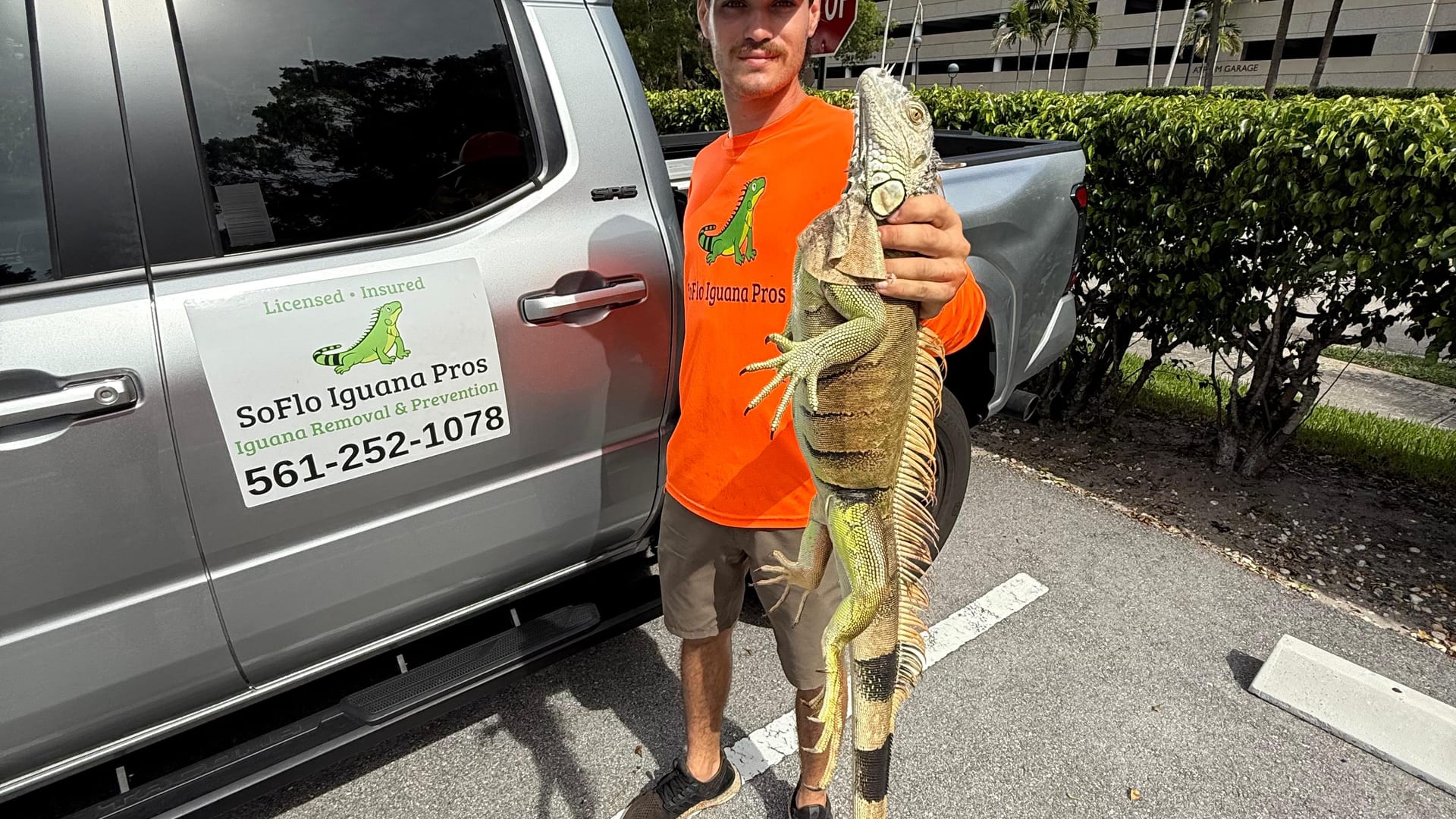
HOA & condo iguana control your board can actually approve
A community-wide program for the lakes, seawalls, and common areas — worked on a schedule, documented after every visit, and priced to the property. We hand your board a written proposal, keep a catch record management can file, and stay one local point of contact from the assessment on.
Licensed
insured · COI on file
Documented
catch & activity reporting
Scheduled
recurring common-area visits
5.0
123+ Google reviews
The problem lives on the shared areas, not the individual lot.
In an HOA or condo, the iguanas breed and burrow on ground the association owns — the lake banks, the seawalls, the amenity decks. Chase them lot by lot and the population just refills from the water. These are the five places we work on a community program.
Retention lakes & canal banks
The soft banks around every community lake are where the population lives and breeds. One quarter-mile bank left alone feeds iguanas into every unit backing onto the water.
Seawalls & bulkheads
On the Intracoastal communities, iguanas den straight into the cap and undermine the wall. That's the line item that turns a nuisance into a five-figure seawall repair the association pays for.
Clubhouse & entrance landscaping
The showpiece beds at the gate and clubhouse are a buffet — hibiscus, bougainvillea, and fresh annuals stripped to stems right where prospective buyers and residents see it first.
Pool decks & amenity areas
Iguanas bask on pool decks, drop into cages residents can't get them out of, and foul the deck and furniture. That's the call that lights up the management line all summer.
Cart paths, sidewalks & curbing
Burrows dug under paths and sidewalks hollow the base out until the concrete cracks and settles — a trip hazard the community carries the liability for until it's fixed.
It isn't just the iguanas. It's answering for them.
A board's exposure on this is bigger than a few chewed hibiscus. When iguanas burrow into a shared seawall or hollow the base out from under a sidewalk, that's a structural repair the association pays for — and a trip-hazard liability it carries until it's fixed. Meanwhile the management office fields the complaints: iguanas on the pool deck, fouling the amenity furniture, stripping the beds at the entrance every prospective buyer drives past.
So the board doesn't just need the iguanas handled — it needs to be able to show they're being handled. A vendor who sprays and disappears leaves nothing to file and nothing to tell residents when they ask what the assessment dollars bought. What actually protects a board is a scheduled program with a paper trail: what was caught, where the pressure is, and a firm scope the community approved up front. That's what we're built to give you.
From assessment to a program the board signs off on.
Every community program follows the same five steps, so the manager knows exactly what to expect and the board has something concrete to approve and point residents to.
- 1
Common-area assessment
We walk the community with the manager — lakes, seawalls, clubhouse beds, amenity decks — and map where the burrows and runs actually are before quoting a dollar.
- 2
Written proposal for the board
A one-page scope, service cadence, and firm price the board can review and approve at the next meeting. No surprise change orders mid-season.
- 3
Scheduled service
Recurring visits on set dates — removal, monitored trapping on the lake banks and seawalls, and burrow collapse — so pressure drops instead of bouncing back.
- 4
Catch & activity reporting
After each visit the manager gets a record of what was caught and where the activity is, in writing, ready to file and share with residents.
- 5
Prevention across the community
Tree wraps, dock-piling guards, and bank work harden the shared areas so the community holds fewer iguanas and the program gets cheaper over time.
Documented, insured, and one number to call.
The difference on a community account isn't just the catch — it's the paper trail and the accountability behind it. Seawall erosion from unchecked burrowing is a real association liability, so we treat the bank work as seriously as the removal, and we put the whole thing in writing management can keep.
- Catch & activity reporting after every visit — a record the board can file
- COI sent to management before we start, association named if you need it
- One local point of contact — Nick — not a call center or a rotating crew
The low bid is usually the one you pay for twice.
Boards get pitched cheap iguana "treatments" all the time. On a community, the corners those bids cut are exactly the ones that leave the association exposed. Four we see over and over:
One-time spray vendors
A truck that fogs the beds and leaves does nothing to the lake bank or the burrows. The iguanas are back off the water within the week and the board paid for a smell.
No reporting for the board
If the vendor can't show what was caught and where, the board has nothing to file, nothing to tell residents, and no way to know the money did anything.
No prevention, just removal
Skimming the visible iguanas without collapsing burrows or guarding banks means a monthly invoice that never ends — the community rents a result instead of buying one.
Unlicensed handling
An unlicensed handler working shared common areas is a liability the association carries. If it isn't humane and FWC-compliant, that exposure lands on the board, not the vendor.
HOA & condo programs across Palm Beach County.
We run community programs on the gated Intracoastal communities in Boca Raton, the equestrian and family associations in Wellington, and the waterfront condos and mid-rises in West Palm Beach — and everywhere between. Based in Lake Worth, so scheduled visits stay on schedule. Pick your city for the local read.
Priced to the community, in writing.
Community programs are custom-priced — there's no per-lot menu, because a compact 40-unit condo with one lake is a different job than a gated community with a mile of Intracoastal seawall and a dozen retention lakes. The common-area assessment is free, and it's where the number comes from: we walk the property with your manager, map the burrows and runs, and hand the board a one-page proposal with the scope, cadence, and a firm price to approve.
What a program includes
- Scheduled removal and monitored trapping on the lake banks, seawalls, and amenity areas.
- Burrow collapse and bank work so seawalls and sidewalks stop getting undermined.
- Catch and activity reporting after each visit — documentation a board can file.
- A COI on file and a single local point of contact from the assessment on.
What sets the price
Mostly the length of lake bank and seawall we're covering, how heavy the starting population is, and how often the common areas need servicing to stay ahead of it. A small condo association lands well below a sprawling country-club community with lakes on every street. Either way the board sees the number before a single visit, and the assessment that produces it costs the community nothing.
Removal, trapping & prevention together
Most community programs pair all three. Removal clears what's there, a monitored trapping program holds the lakes and seawalls, and prevention — wraps, piling guards, and burrow collapse — shrinks what the community can hold so the program gets cheaper over the season. Run a course too? We handle golf-course lakes and greens the same way, from a gated club in Boca Raton to community lakes in Wellington.
Community work around the county.
Real jobs from Palm Beach County HOAs and condos — lake banks, seawalls, and clubhouse landscaping, with the prevention that keeps the numbers down between visits.
Tap any photo to enlarge
What boards and managers say.
HOA iguana control questions.
Bringing this to your board?
Call or text Nick — he'll walk the community and get a written proposal to management before your next meeting.
Call (561) 735-1975Do you provide documentation and reporting for the board?
Yes — every community program includes catch and activity reporting the manager can file and hand to residents. After each visit you get a written record of what was caught and where the activity is concentrating, so the board can show the money is doing something instead of taking it on faith. That reporting is exactly what most one-time spray vendors can't give you.
Are you licensed and insured — can you send a COI?
Yes. We're licensed, insured, and FWC-compliant, and we send a certificate of insurance to management before the first visit — naming the association as additional insured if your governing documents require it. An unlicensed handler working shared common areas is a liability the association ends up carrying, which is exactly what a COI on file protects you from.
How do you price a community program?
To the community, not off a menu. Price comes down to how much lake bank and seawall we're covering, how heavy the starting population is, and how often the common areas need servicing to stay ahead of it. We walk the property first, then hand the board a one-page written proposal with the scope, cadence, and a firm price — free, and before anyone commits.
Can you work our whole community's lakes and seawalls?
That's the core of what we do for HOAs and condos. We run monitored trapping and removal along retention-lake banks and Intracoastal seawalls, collapse the burrows undermining the bank, and guard dock pilings — across the whole community on one scheduled program, not lot by lot. Communities in Boca Raton, Wellington, and West Palm Beach are a big part of our week.
Will residents be disturbed, and is the work humane?
No, and yes. We service common areas quietly on scheduled dates, without poisons or air-rifle theatrics anywhere near units, pools, or pets. Green iguanas are invasive in Florida and every capture is handled humanely and under FWC guidelines, so the board never has to field a complaint about how the work was done.
How fast can you present to our board?
Quickly. We're based in Lake Worth, so we can usually walk a Palm Beach County community within a few days and have a written proposal in the manager's inbox before your next meeting. Call or text Nick at (561) 735-1975 and we'll get the assessment on the calendar.