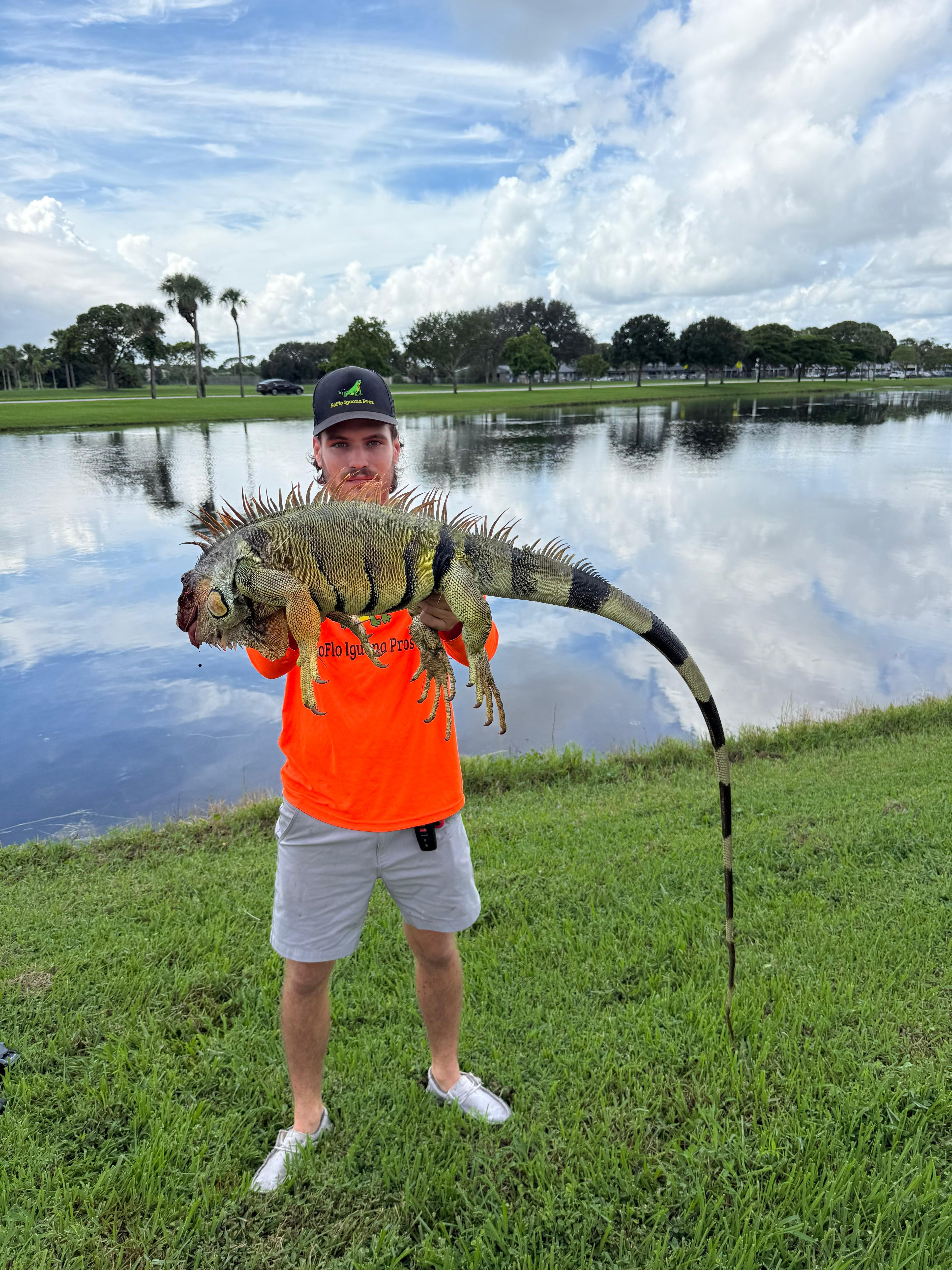

A big iguana bites hard, whips its tail like a switch, and carries salmonella. Here's the safe way to catch one — and an honest take on when to leave it to us.
I'll start with the part most guides bury: a large iguana is genuinely capable of hurting you. That tail is a muscular whip that leaves welts, the claws rake, and the bite of an adult can take a chunk. On top of that, they carry salmonella on their skin and in their droppings. None of that means they're monsters — it means you catch one with respect and the right gear, or you don't catch it at all.
It's also worth knowing the legal frame. In Florida, green iguanas are invasive and unprotected, so you can catch and humanely remove them from your own property year-round without a permit. What you cannot do is relocate and release them somewhere else — that's not legal — and if the animal is dispatched, it has to be done humanely. That responsibility is a big reason people would rather hand the catch off.
Gear up before you go near one
Bare hands are how people get hurt. Thick gloves, long sleeves, eye protection, and closed shoes are the minimum for anything bigger than a juvenile. You want a barrier between you and the claws, tail, and teeth, and you want to keep the animal's mouth and the salmonella away from your face and any cuts.
- Thick leather or bite-resistant gloves — not garden gloves.
- Long sleeves and eye protection against the tail whip.
- A towel or pillowcase to cover the eyes and calm the animal once controlled.
- Hand-washing lined up for immediately after — salmonella is the reason.
The safest catch: control the head and the base of the tail
If you're going hands-on with a manageable animal, the technique is to control two points — behind the head so it can't turn and bite, and the base of the tail so it can't whip. Approach from behind and low, get those two holds, and immediately cover the eyes with a towel, which settles most iguanas quickly. A calm, covered iguana is far safer to handle than a thrashing exposed one.
Never grab an iguana by the tail alone. They can drop the tail to escape — it detaches by design — and you're left with a wound-up animal and a piece of tail, which helps nobody.
Traps: better for most people than a hand catch
For most homeowners, a live trap set on the animal's actual route is smarter and safer than trying to grab one. But a trap is only as good as its placement and your discipline in checking it. Set it where they travel — the seawall cap, the bank, the base of a favorite tree — not out in the open lawn where nothing walks.
- Place traps on the routes iguanas actually use, sized for the animals you're seeing.
- Check traps frequently — an animal left in a hot trap for hours isn't humane or legal.
- Have a plan for the caught animal before you set the trap, since you can't relocate and release it.
- Keep the trap and your hands out of reach of a caught adult's snout.
When not to try — call instead
Be honest with yourself about the animal in front of you. A five-foot male, a cold-stunned one that could revive violently, anything cornered on a roof or a screen frame, or a situation where you're not sure what to do with it after — those are the ones to leave alone. The catch is the flashy part; the humane, legal handling afterward is the part that trips people up.
That's where we come in. Our single visits start at $189, the property walk is free, and if it's a recurring problem the monitored programs run from $99 a month with no lock-in. There's no shame in deciding a big adult isn't worth a hospital visit or an amateur mistake.
Questions we hear
Is it legal to catch and keep or move an iguana in Florida?
You can legally catch and humanely remove green iguanas from your own property year-round without a permit, because they're invasive and unprotected. What you can't do is relocate and release them elsewhere — that's prohibited — and any dispatch must be humane. Those rules are why many people prefer to hand the catch off.
How dangerous is catching an iguana, really?
A large one can bite hard, whip its tail into a welt, rake with its claws, and carries salmonella on its skin and droppings. With thick gloves, sleeves, eye protection, and the right two-point hold it's manageable, but a big adult is a genuine injury risk and not a bare-hands job.
Should I grab it by the tail?
No. Iguanas can drop their tail to escape by design, so you'll likely end up with a detached tail and a loose, angry animal. Control the animal behind the head and at the base of the tail together, then cover its eyes with a towel to calm it — or use a well-placed live trap instead.
Services in this guide