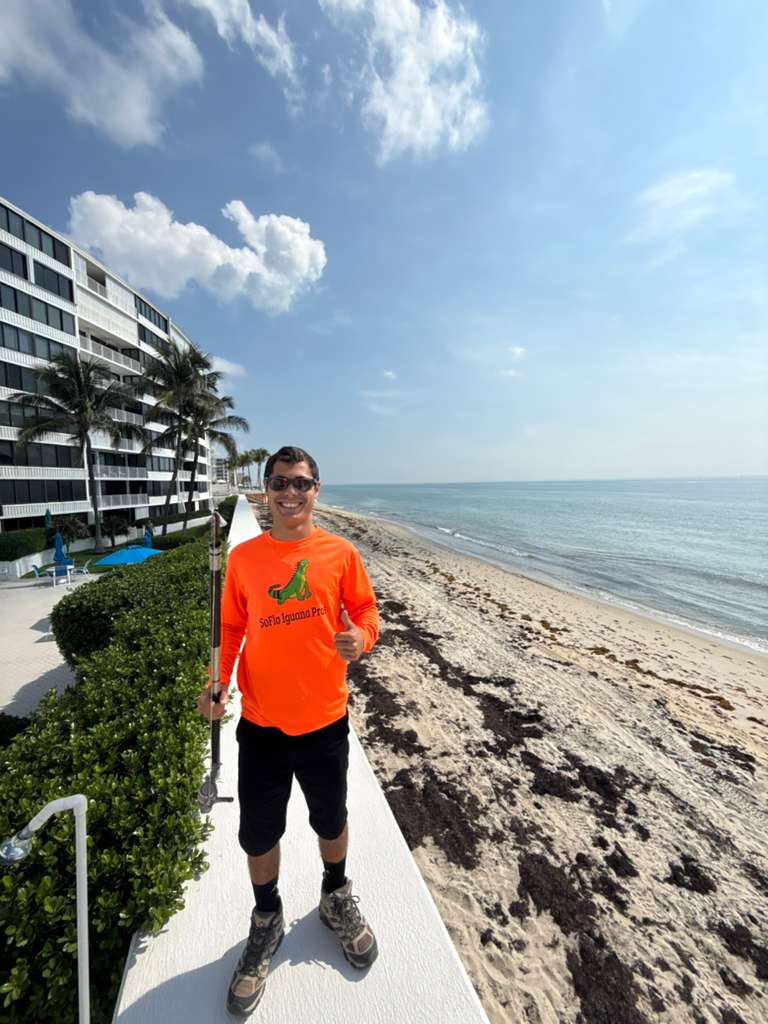

Shoveling dirt into the hole is why your burrows keep re-opening. Here's how to actually collapse and pack one so it stays closed.
Filling burrows is the most misunderstood part of iguana work. People find a half-moon hole at the seawall, dump a shovelful of dirt in, tamp it with a foot, and figure they're done. Three days later it's open again, sometimes a foot to the side. The reason is almost always the same: the animals are still using the bank, and the fill wasn't done in a way that could actually hold.
Done right, burrow work does two things at once — it stops the erosion that's hollowing out your bank or slab, and it removes a ready-made den so new animals don't just move in. Done wrong, it's exercise.
Rule one: don't fill an occupied burrow
This is the piece that trips everyone up. If you pack a burrow while iguanas are still living in the bank, one of two bad things happens: you trap an animal inside, or a living animal simply re-digs within a day. Neither helps you, and sealing an iguana in isn't humane. Clear the residents first — trap and remove them — and then close the dens behind them.
There's also the practical matter of not knowing what's home. A burrow can run several feet and branch, and in spring it may hold a clutch of eggs. You want to know it's empty before it's packed.
How to actually collapse and pack one
A burrow that stays closed is collapsed and compacted in layers, not topped off. The goal is to eliminate the void, not cap it, so there's nothing hollow left to re-open or wash out.
- Confirm it's empty first — this is the non-negotiable step, and in spring it means checking for eggs.
- Collapse the tunnel itself where you can, not just the mouth, so you're removing the void rather than plugging one end.
- Backfill in layers, tamping each layer firmly, ideally with a compactable soil or a soil-and-gravel mix rather than loose sand.
- Bring the fill flush and firm at the surface so there's no soft dimple that invites a re-dig.
- Re-check after the next heavy rain — settling can reveal a void you missed.
Near a seawall or slab, be careful
If the burrow runs under a seawall cap, a pool deck, or a driveway slab, you may be looking at more than a hole — the void under the concrete can already be undermining it. Packing the visible mouth doesn't fix a hollow the size of a basketball under your pool deck. If the cap is cracking or the slab is settling, that's a structural repair for a marine or concrete contractor, and the iguana work is about stopping the cause so the repair isn't undermined again.
We're glad to time our removal and burrow collapse with a contractor's repair so the backfill goes in clean and stays that way.
Why it keeps re-opening even when you do it right
If you've cleared the animals and packed the burrows properly and they still come back, you're almost certainly on a pressured waterline — the neighbor's bank keeps sending new diggers, especially through spring nesting. That's not a failure of technique; it's a supply problem, and it's why heavily pressured waterfront lots do better on a monitored program that re-packs fresh diggings before they become dens. Ours start at $99 a month with no lock-in, and the property walk to see whether you need that is free.
Questions we hear
Can I just fill the burrow and be done?
Rarely. If the iguanas still live in the bank they re-dig within days, and a burrow filled with loose sand slumps and re-opens after rain. Filling only holds when the residents are cleared first and the tunnel is collapsed and compacted in layers, not just topped off at the mouth.
How do I know if a burrow is occupied?
You often can't tell from the surface, which is exactly the problem — burrows run several feet, branch, and in spring may hold eggs. The safe approach is to remove the resident iguanas first so you're closing empty dens, rather than risk sealing an animal or a clutch inside.
There's a burrow under my pool deck — is that a problem?
Potentially a serious one. A tunnel under a slab can hollow out the support and lead to settling and cracks, and packing the mouth won't fix a void already under the concrete. If the deck is settling or cracking, get a concrete contractor involved, and clear the iguanas so the repair isn't undermined again.
Services in this guide